Jeet Kune Do : 9 July 1967
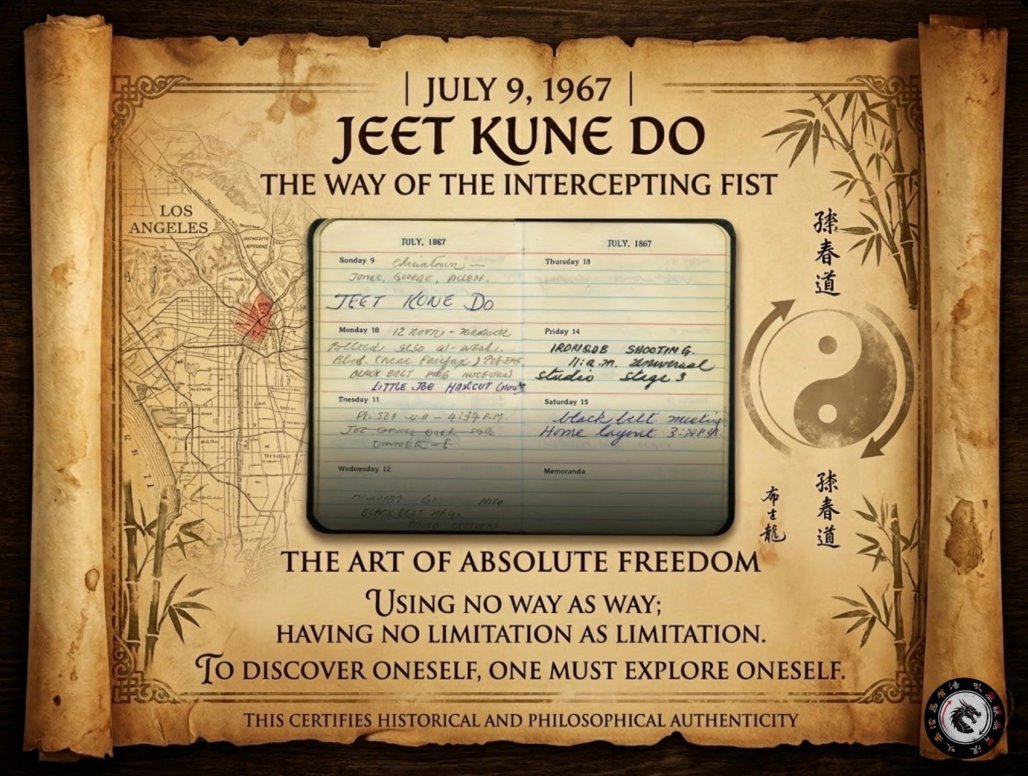
July 9, 1967 – Jeet Kune Do: The Way of the Intercepting Fist and the Art of Absolute Freedom
In Bruce Lee's personal diary, on Sunday, July 9, 1967, three words were written with quiet determination: Jeet Kune Do. This seemingly simple act did not merely mark the birth of yet another discipline in the long and rich history of martial arts. It signaled a radical break, a philosophical earthquake. Translated as "The Way of the Intercepting Fist," JKD is the dazzling culmination of a deep inner struggle within its creator: the perpetual tension between the human need for structure and the unquenchable thirst for absolute freedom.
Crystallization: The Inherent Danger of a Name
Naming a thing often means defining it, and consequently, limiting it. Bruce Lee struggled for a long time with the very idea of putting a label on his martial expression. His greatest fear was that of "crystallization": the fatal moment when a living, fluid, and evolving idea transforms into a rigid dogma.
For Lee, to freeze knowledge is to condemn it to death. A classical style imposes repetitive patterns that ultimately imprison the practitioner. Yet, for the sake of transmission and communication, the practical necessity of designating his art prevailed.
To counter this risk of stagnation and to remind people of the evolving nature of his approach, he anchored Jeet Kune Do in a powerful visual and philosophical symbol, his Core Symbol: the Taijitu emblem (illustrating the dynamic balance of Yin and Yang), surrounded by two arrows representing impermanence and perpetual motion. This symbol is crowned by a motto that summarizes Lee's entire epistemology:
"Using no way as way; having no limitation as limitation."
The Essence of Interception: A Mechanics of the Mind
The term "Intercepting Fist" does not only describe a combat technique; it defines the overall mechanics and the intimate psychology of his approach. The idea of intercepting is the keystone of JKD, unfolding on several levels:
-
Technical interception: This involves stopping the opponent's attack at the exact moment it is launched, using the other's momentum against them. It is the economy of motion pushed to its climax.
-
Interception of intent: This is the higher stage. It is about perceiving the desire, the muscle contraction, or the shift in the opponent's gaze before their body even unfolds in space.
Achieving this lightning speed requires operating from a state of "Being-ness" (a state of pure being, of total presence). In this altered state of consciousness, the practitioner is so cultivated, so empty of parasitic thoughts, that the martial tools emerge instantly. Faced with the chaos of a conflict, action becomes an organic and spontaneous response, not a calculated intellectual reaction that would always arrive a fraction of a second too late.
The Three Guiding Principles
Rather than accumulating an infinite catalog of techniques, Bruce Lee chose the path of subtraction. He refined his practice around three fundamental pillars that govern every movement:
-
Simplicity: Ruthlessly eliminating everything that is superfluous, decorative, or ritualistic. Keeping only the functional core.
-
Directness: Reaching the target by the shortest and fastest route, without detours or telegraphed movements.
-
Freedom: Adopting the "form of no-form." Like water adapting to the vessel that contains it, the practitioner must be able to embrace any situation without being imprisoned by the rules of a particular style.
A Psychology of Liberation
The genius of Jeet Kune Do lies in the fact that it does not stop at the dojo doors. Its principles are direct metaphors for facing difficult life situations.
Bruce Lee considered traditional and highly organized styles as mental prisons. For him, truth—whether martial, philosophical, or personal—cannot be institutionalized. Predefined forms (katas or taolus) are reassuring but deceptive conditioning, because they prevent the individual from responding to the chaotic, asymmetrical, and ever-changing reality of the present moment.
Above all, JKD celebrates the honest expression of oneself. The ultimate goal was never to learn to imitate Bruce Lee's movements. Rather, it is about using the tools he left behind to discover one's own anatomical and psychological truth. It is a process of permanent pruning, similar to the work of a sculptor: one does not add a block of clay every day; instead, one removes the useless to reveal the masterpiece hidden inside.
The Manifesto of the Individual
On that famous July 9, 1967, Bruce Lee did not just name an art; he opened a path requiring total autonomy and responsibility. Jeet Kune Do is not a final destination where one obtains a black belt or a diploma of completeness. It is an ongoing journey toward absolute honesty with oneself.
It is having the courage to look at oneself without complacency in the mirror of existence, to shatter one's own illusions of security, and to dare to express who one truly is, without filters and without excuses.
Bruce Lee's final injunction resonates today not only as the foundation of JKD, but as the supreme guide for any quest for personal emancipation:
"Research your own experience. Absorb what is useful. Reject what is useless. Add what is essentially your own."