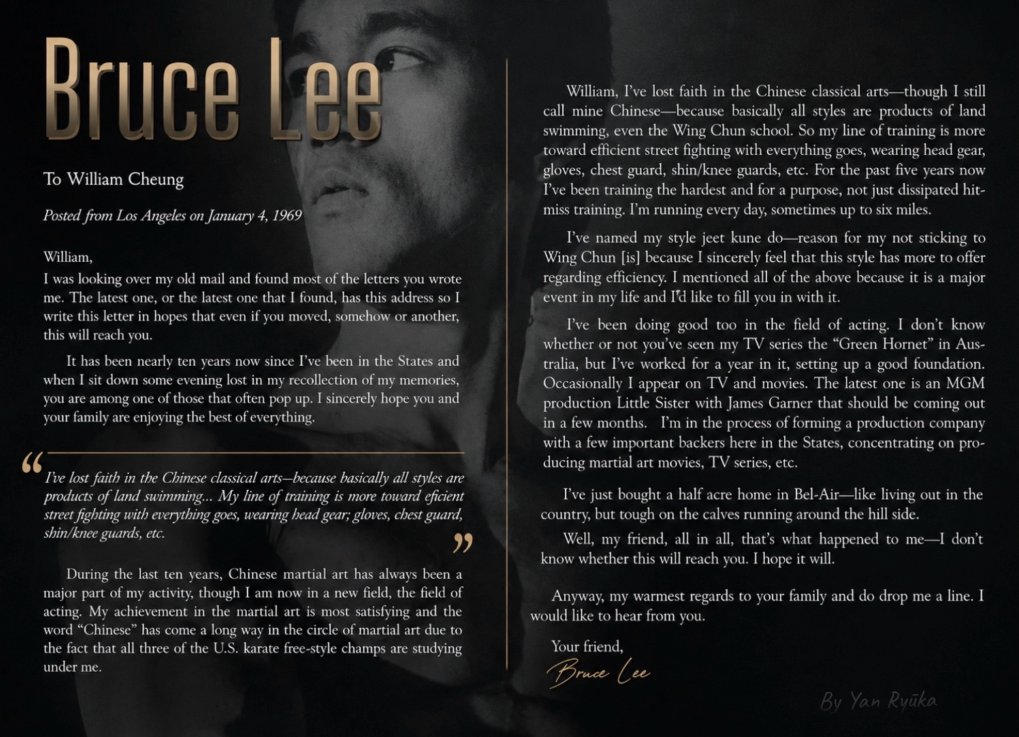
Bruce Lee, January 4, 1969 a letter to William Cheung
THE EMANCIPATION OF COMBAT: FROM LAND SWIMMING TO THE SCIENCE OF INTERCEPTION
THE EMANCIPATION OF COMBAT: FROM LAND SWIMMING TO THE SCIENCE OF INTERCEPTION
"I've lost faith in the Chinese classical arts – though I still call mine Chinese – because basically all styles are products of land swimming, even the Wing Chun school. So my line of training is more toward efficient street fighting with everything goes, wearing head gear, gloves, chest guard, shin/knee guards, etc."
— Bruce Lee, January 4, 1969
On January 4, 1969, a letter acted as a scalpel on martial dogma. Many mistakenly believe that jeet kune do is nothing more than a modified wing chun system with the addition of some long-range kicks. In reality, this note marks the end product of Bruce Lee's martial arts evolution, including a drastic change in approach and attitude to the fighting arts.
This is the absolute tipping point of the Los Angeles era (1967–1971). It is the birth of absolute functional sovereignty: the refusal to remain a prisoner of a closed system in order to embrace the brutal truth of movement.
1. THE FRACTURE: DESTROYING THE ILLUSION OF "LAND SWIMMING"
The metaphor of "land swimming" perfectly illustrates the failure of classical training. It became evident that practicing pre-arranged forms did not effectively and efficiently prepare a student for combat.
To survive the chaos of a real confrontation, contact drills and full-contact sparring became increasingly important. Eventually, chi sao and wing chun wooden dummy workouts became non-existent in Bruce Lee's training by the late 1960s. We no longer repeat dead routines on static targets; we face living, non-cooperative opposition.
2. THE LABORATORY: EQUIPMENT AS THE REVEALER
Why insist on head gear, gloves, and chest guards in this manifesto? Because equipment is the only vehicle that introduces the reality of impact. To distance himself from theory, many of the training and conditioning exercises from boxing became heavily adopted such as using the heavy bag, the top and bottom bag, and the focus pad.
Putting on gloves and headgear forces you to test your own biomechanics under absolute pressure. Without this equipment, intensity is merely simulated. With it, classical illusions collapse.
3. THE "LATER STAGE": THE PURE SCIENCE OF INTERCEPTION
Once the classical structures are discarded, the space is left exclusively for pure efficiency and distance management. In this Later Stage, Jeet Kune Do rests on ruthless biomechanical principles:
-
Countless hours were spent on developing smooth and rapid footwork to bridge and maintain distance, thus allowing Lee to quickly get in and out of a confrontation.
-
Such issues as initial movement, non-telegraphic motion, economy of motion, efficiency, and the lead hand/foot became vital in jeet kune do.
The posture of the Bai Jong is no longer a traditional, rooted stance. It is a highly mobile launching pad, with the rear heel raised, engineered specifically to propel the Straight Lead with maximum penetration and zero telegraphy.
4. BE YOUR OWN SIFU: THE CONTINUOUS EXPLORATION
To truly understand this 1969 text is to realize that JKD is not a new, rigid style bound by hierarchy and static certifications. It is an exploration. What Bruce Lee called "hacking away the unessentials" was his way of streamlining his fighting arsenal to its bare essentials.
The ultimate goal is not to accumulate the techniques of other styles, but to achieve total liberation of the individual. Jeet kune do is all about doing what is instinctual and natural. It is simply about being yourself.
"Stop swimming on dry land: Hacking away the unessentials to reach absolute functional sovereignty."
* NOTE : Ted Wong Evolution training in JKD - article in files
Pièce jointe