THE PHILOSOPHERS AND BRUCE LEE: TOWARD SPONTANEOUS LIBERTY
Thus, Bruce Lee did not only transcend martial arts. He transcended traditional thought, becoming a true living philosopher who continues to inspire practitioners and seekers of truth throughout the world.
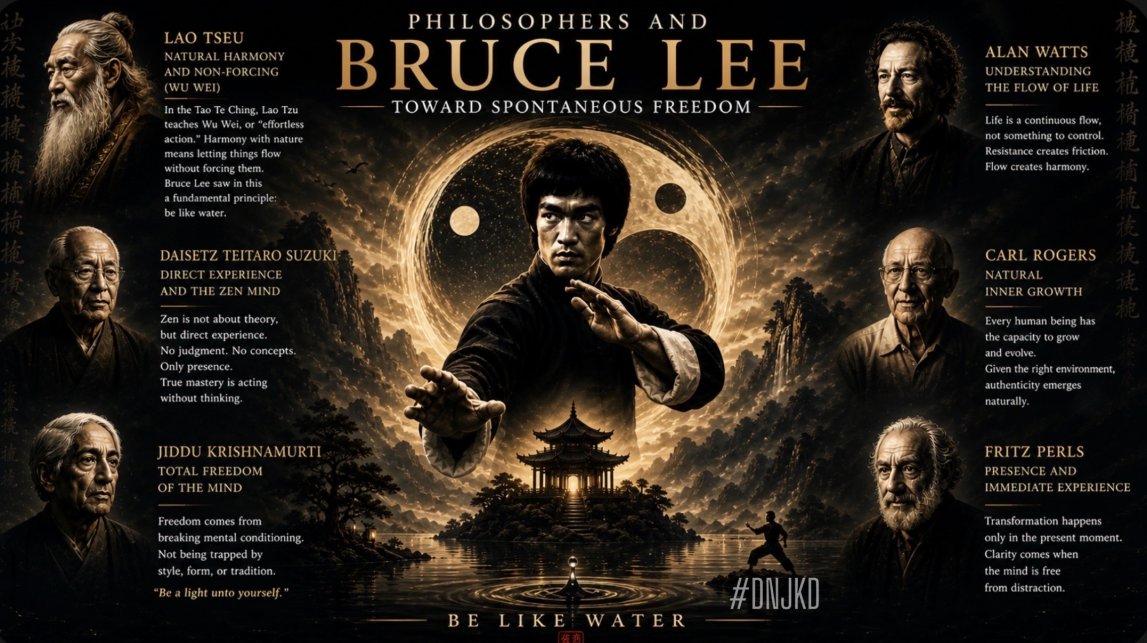
The Philosophers and Bruce Lee: Toward Spontaneous Liberty
Bruce Lee was not merely a martial arts master with breathtaking movements. Behind every strike delivered and every stance assumed lay a profound depth of thought, forged by centuries of philosophy and spiritual exploration. Lee did not simply follow martial traditions; he sought a path of freedom, adaptation, and fluidity.
What is fascinating is that this quest—beyond mere technique—echoed a series of thinkers who, long before him, explored the nature of the human spirit and our place in the world.
These great philosophers, often overlooked by the masses, nourished his reflection and shaped his vision of martial arts. From Lao Tzu to Krishnamurti, their teachings, as well as those of Watts and Rogers, offered Bruce Lee a true way of life—a path of inner liberation that went far beyond simple punches and kicks. However, it is vital to note that Bruce Lee was himself a philosophical thinker. Much more than a practitioner, he developed and formulated his own philosophy, reaching a profound understanding of existence that transcended physical techniques.
Oriental Foundations: Flow and Instinct
Lao Tzu: Natural Harmony
Imagine a combat that does not resist the opponent’s force but accepts and adapts to it. This idea stems directly from Lao Tzu, the Taoist master. In his Tao Te Ching, Lao Tzu advocates the notion of Wu Wei, or "effortless action." For him, harmony with nature is essential: it is about letting things flow and not forcing events.
In developing his philosophy of Jeet Kune Do, Bruce Lee saw this wisdom as a fundamental principle: "Be water."Water adapts to everything; it imposes nothing and follows the current, yet it is capable of sweeping away everything in its path. The essence of Lee’s martial art is a fluid dance, a constant adaptation to movement.
Daisetz Teitaro Suzuki: Direct Experience
While Lao Tzu taught Lee the importance of fluidity, Daisetz Teitaro Suzuki, the Japanese Zen master, pushed him further into the idea of direct experience. Zen, according to Suzuki, is not interested in theoretical analysis but in immediate experience. No judgment, no conceptions—just absolute presence in the moment.
Bruce Lee embraced this idea of living without an intellectual filter. When he fought, he did not think about the strikes; he felt them and executed them instinctively and spontaneously. True mastery, he said, is to act without thinking, by being totally present.
Jiddu Krishnamurti: Total Freedom of Mind
Similarly, Jiddu Krishnamurti, the Indian philosopher, profoundly influenced how Lee conceived of inner freedom. Krishnamurti always insisted that real freedom comes from transcending mental conditioning. Bruce Lee often emphasized the importance of not being a prisoner of a style, a form, or a tradition. He wanted his students to break free from external constraints to develop their own way.
"Be a light unto yourself." — Jiddu Krishnamurti
It is not an external quest, but an internal exploration. Combat is not just physical; it is, above all, mental.
Alan Watts: Understanding the Flow of Life
Another major thinker for Bruce Lee was Alan Watts, the British philosopher who introduced the West to the teachings of Taoism, Buddhism, and Zen. For Watts, life is a continuous flow, a cosmic play that is not to be controlled, but to be lived.
This worldview resonated deeply with Lee, who saw martial arts as a natural dance—an exchange of energies rather than a struggle. He understood that, as in nature, one must be carried by energy and be in phase with it during combat. Any resistance to this flow created confusion and exhaustion. This principle is at the heart of martial adaptability and spontaneous reaction in Jeet Kune Do.
The Contribution of Western Psychology: Growth and Presence
Carl Rogers: Natural Inner Growth
Beyond Eastern philosophy, Bruce Lee was also inspired by the ideas of Carl Rogers, the humanist psychologist. According to Rogers, every human being possesses a natural capacity to grow, flourish, and develop if the environment allows them to be authentic.
This idea deeply marked Lee’s way of teaching. He believed in a non-dogmatic approach where every practitioner could find their own path, their own form of personal liberation. In other words, Lee did not impose a style; he provided the means for his students to discover themselves. It was this inner growth that he considered essential.
Fritz Perls: The Present Moment
Finally, Fritz Perls, psychotherapist and founder of Gestalt therapy, influenced Bruce Lee in his conception of absolute presence. Perls believed that true healing and transformation could only occur when one was fully anchored in the here and now.
Lee transposed this idea into his martial practice, where reflection was eliminated to make room for immediate action. The mind had to be clear and free of distractions. For Lee, every moment of combat was a unique instant where mindfulness allowed for a perfect response.
A Common Path: Freedom and Fluidity
All these thinkers point in a fundamental direction: toward inner freedom and fluidity. Their message resonates deeply with Bruce Lee's vision: the idea that in all things, one must be oneself, adapt to circumstances, and never allow oneself to be imprisoned by forms, dogmas, or external structures.
Bruce Lee’s Jeet Kune Do is not simply a system of martial arts. It is an inner quest based on freedom, spontaneity, and total presence. Lee did not seek to create a fixed style, but a living art in perpetual evolution.
Synthesis of Influences
| Thinker | Central Concept Applied to Jeet Kune Do |
|---|---|
| Lao Tzu | Natural harmony and non-forcing (Wu Wei) |
| D.T. Suzuki | Direct experience and the "Zen mind" |
| J. Krishnamurti | Total freedom of mind without conditioning |
| Alan Watts | Understanding and accepting the flow of life |
| Carl Rogers | Natural and authentic inner growth |
| Fritz Perls | Absolute presence and immediate experience |
Thus, Bruce Lee did not only transcend martial arts. He transcended traditional thought, becoming a true living philosopher who continues to inspire practitioners and seekers of truth throughout the world.
Yan Lfr