THE ESSENCE OF JEET KUNE DO: THE SCIENCE OF OPTIMIZATION
Jeet Kune Do is not a collection of techniques borrowed from other styles. It is a common misconception to believe that JKD consists of compiling a Muay Thai kick and a Karate punch. While a practitioner may choose to include such movements, that falls under their own personal expression
THE ESSENCE OF JEET KUNE DO: THE SCIENCE OF OPTIMIZATION
Jeet Kune Do is not a collection of techniques borrowed from other styles. It is a common misconception to believe that JKD consists of compiling a Muay Thai kick and a Karate punch. While a practitioner may choose to include such movements, that falls under their own personal expression—it is not what defines Bruce Lee’s Jeet Kune Do.
JKD is a scientific modification. Bruce Lee studied various arts, not to copy them, but to extract their underlying principles and improve them biomechanically. Every tool retained was scrutinized to meet three criteria: simplicity, directness, and non-telegraphic efficiency.
1. Biomechanical Improvement
JKD modifies the very structure of the strike. Where a traditional style might prioritize visible rotation or "chambering" the blow, JKD optimizes the kinetic chain.
-
We do not strike "with" the arm; we project the body’s mass through perfect bone alignment.
-
Every technique is "sharpened" to travel along the shortest path, stripped of any parasitic movement.
2. The Technical Nucleus (The Bruce Lee Standard)
Bruce Lee’s Jeet Kune Do possesses its own arsenal, specifically modified for interception:
-
The Straight Lead: This is not a jab. It is a spear propelled by the rear foot, utilizing gravity drop and hip rotation for maximum penetration without recoil.
-
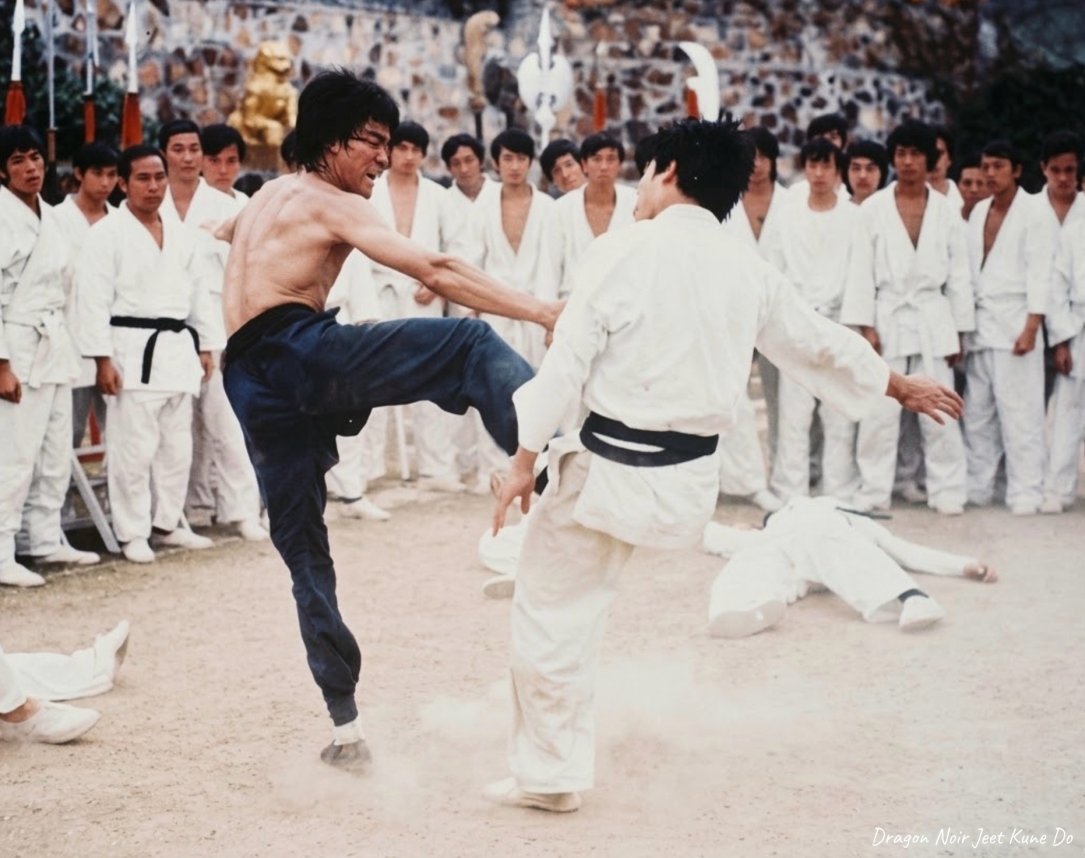
The Stop-Kick: This is not a Karate kick. It is a low-line interception, driven by the heel, aimed at destroying the opponent’s advance at the exact moment of their intent.
3. Purposeful Simplicity
JKD does not seek to accumulate; it seeks to distill. We do not add techniques to fill a void; we sharpen the core tools until they become neurological reflexes.
In summary: Jeet Kune Do is the result of scientific research on the human body in motion. It is not about "doing everything"; it is about "doing it better" by applying the laws of physics. Everything else—the addition of personal techniques—comes later, only once the foundational tool has been mastered and optimized.
"Bruce Lee studied various arts, not to copy them, but to extract their principles and improve them biomechanically. Every tool retained was scrutinized to meet three criteria: simplicity, directness, and non-telegraphic efficiency."
"The individual over the style: In JKD, the human being is more important than any established system. Philosophy serves to break mental patterns so that the practitioner is no longer an automaton repeating gestures, but a human being expressing himself with total honesty."
——————————————————————————————————————————————————
L'ESSENCE DU JEET KUNE DO : LA SCIENCE DE L'OPTIMISATION
Le Jeet Kune Do n'est pas une collection de techniques empruntées à d'autres styles. C'est une erreur commune de croire que le JKD consiste à compiler un coup de pied de Muay Thai et un coup de poing de Karaté. Bien qu'un pratiquant puisse choisir d'inclure de tels mouvements, cela relève de sa propre expression personnelle — ce n'est pas ce qui définit le Jeet Kune Do de Bruce Lee.
Le JKD est une modification scientifique. Bruce Lee a étudié divers arts, non pas pour les copier, mais pour en extraire les principes fondamentaux et les améliorer biomécaniquement. Chaque outil conservé a été passé au crible pour répondre à trois critères : la simplicité, la directivité et l'efficacité non-télégraphique.
1. L'Amélioration Biomécanique
Le JKD modifie la structure même de la frappe. Là où un style traditionnel pourrait privilégier la rotation visible ou l'armement du coup (« chambering »), le JKD optimise la chaîne cinétique.
-
On ne frappe pas « avec » le bras ; on projette la masse du corps à travers un alignement osseux parfait.
-
Chaque technique est « aiguisée » pour voyager sur la ligne la plus courte, dépouillée de tout mouvement parasite.
2. Le Noyau Technique (Le Standard de Bruce Lee)
Le Jeet Kune Do de Bruce Lee possède son propre arsenal, spécifiquement modifié pour l'interception :
-
Le Straight Lead : Ce n'est pas un jab. C'est une lance propulsée par le pied arrière, utilisant la chute de gravité et la rotation des hanches pour une pénétration maximale sans recul.
-
Le Stop-Kick : Ce n'est pas un coup de pied de Karaté. C'est une interception sur la ligne basse, déclenchée avec le talon, visant à détruire l'avancée de l'adversaire au moment précis de son intention.
3. La Simplicité Volontaire
Le JKD ne cherche pas à accumuler ; il cherche à distiller. On ne rajoute pas des techniques pour combler un vide ; on aiguise les outils de base jusqu'à ce qu'ils deviennent des réflexes neurologiques.
En résumé : Le Jeet Kune Do est le résultat d'une recherche scientifique sur le corps humain en mouvement. Il ne s'agit pas de « tout faire » ; il s'agit de « faire mieux » en appliquant les lois de la physique. Tout le reste — l'ajout de techniques personnelles — vient plus tard, seulement une fois que l'outil fondamental a été maîtrisé et optimisé.
« Bruce Lee a étudié divers arts, non pas pour les copier, mais pour en extraire les principes et les améliorer biomécaniquement. Chaque outil conservé a été passé au crible pour répondre à trois critères : la simplicité, la directivité et l'efficacité non-télégraphique. »
« L'individu avant le style : En JKD, l'être humain est plus important que n'importe quel système établi. La philosophie sert à briser les schémas mentaux pour que le pratiquant ne soit plus un automate répétant des gestes, mais un être humain s'exprimant avec une honnêteté totale. »