The Three Stages of a Technique
These handwritten notes (by Bruce Lee) illustrate a deeply logical and scientific approach to learning martial arts
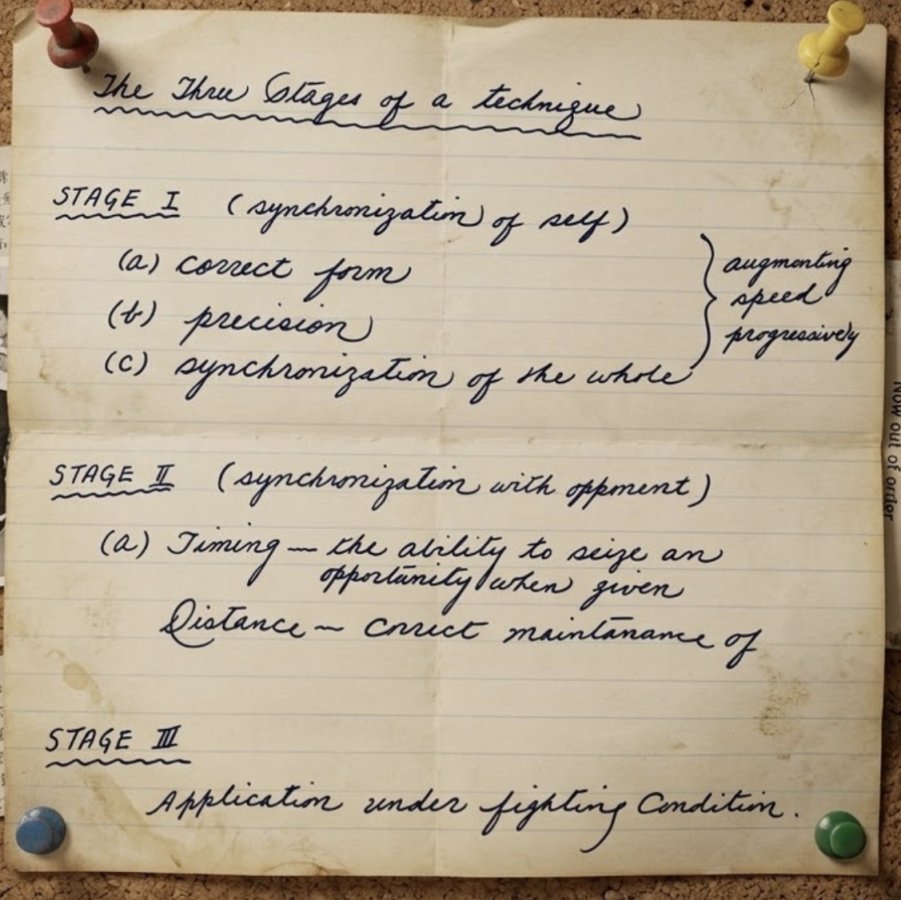
How can we ensure that a movement practiced in a vacuum will actually work against an opponent? Martial arts training leaves no room for chance or illusion. It must follow a logical and ruthless progression: first the mastery of oneself, then the adaptation to the timing and distance of the other, and finally the test of reality.
The Three Stages of a Technique
STAGE I (synchronization of self)
(Note: augmenting speed progressively)
-
(a) Correct form
-
(b) Precision
-
(c) Synchronization of the whole
STAGE II (synchronization with opponent)
-
(a) Timing — the ability to seize an opportunity when given.
-
Distance — correct maintenance of distance.
STAGE III
-
Application under fighting condition.
Conclusion & Understanding
These handwritten notes (by Bruce Lee) illustrate a deeply logical and scientific approach to learning martial arts. They teach us that mastering a technique does not happen by magic, but follows a strict progression in three dimensions:
-
Internal Mastery (Stage I): Before thinking about the opponent, the practitioner must master themselves. This involves pure body mechanics (form), the accuracy of the movement (precision), and whole-body coordination. Speed is only added once the mechanics are perfect.
-
Relational Mastery (Stage II): A perfect technique in thin air is useless against a moving target. This stage is crucial because it introduces the two ruling concepts of combat: the exact moment to strike (timing) and the exact space to reach the target safely (distance). The focus shifts from oneself to the opponent.
-
Validation through Reality (Stage III): This is the final test. The technique must survive the chaos and stress of a real confrontation (or hard sparring). If it fails here, the practitioner must return to the previous stages to correct the flaws.
In summary: This document demonstrates that to make a technique "alive" and applicable, one must transition from simple isolated body mechanics to an acute awareness of time and space against an opponent, and finally test everything in the chaos of real combat. This is the very essence of moving from martial arts theory to actual practice.
——-–——-—————————————————————————————————————————————
Comment s'assurer qu'un mouvement répété dans le vide fonctionnera réellement face à un adversaire ? L'apprentissage martial ne laisse pas de place au hasard, ni à l'illusion. Il doit suivre une progression logique et impitoyable : d'abord la maîtrise de soi-même, ensuite l'adaptation au timing et à la distance de l'autre, et enfin l'épreuve de la réalité.
Les trois étapes d'une technique
ÉTAPE I (synchronisation de soi)
(Note : en augmentant la vitesse progressivement)
-
(a) Forme correcte
-
(b) Précision
-
(c) Synchronisation de l'ensemble
ÉTAPE II (synchronisation avec l'adversaire)
-
(a) Le Timing — la capacité de saisir une opportunité lorsqu'elle se présente.
-
La Distance — le maintien correct de la distance.
ÉTAPE III
-
Application en conditions de combat.
Conclusion de compréhension
Ces notes manuscrites (de Bruce Lee) illustrent une approche profondément logique et scientifique de l'apprentissage des arts martiaux. Elles nous apprennent que la maîtrise d'une technique ne se fait pas par magie, mais suit une progression stricte en trois dimensions :
-
La maîtrise interne (L'Étape I) : Avant de penser à l'adversaire, le pratiquant doit se maîtriser lui-même. Cela passe par la mécanique corporelle pure (la forme), la justesse du geste (la précision) et la coordination de tout le corps. La vitesse n'est ajoutée qu'une fois la mécanique parfaite.
-
La maîtrise relationnelle (L'Étape II) : Une technique parfaite dans le vide ne sert à rien face à une cible mouvante. Cette étape est cruciale car elle introduit les deux concepts rois du combat : le moment précis où frapper (timing) et l'espace exact pour l'atteindre en sécurité (distance). L'attention passe de soi-même à l'autre.
-
La validation par le réel (L'Étape III) : C'est le test final. La technique doit survivre au chaos et au stress d'un véritable affrontement (ou d'un sparring appuyé). Si elle échoue ici, il faut retourner aux étapes précédentes pour corriger les défauts.
En résumé : Ce document démontre que pour rendre une technique "vivante" et applicable, il faut passer de la simple mécanique corporelle isolée à une conscience aiguë du temps et de l'espace face à un opposant, pour finalement tester le tout dans le chaos du combat réel. C'est l'essence même du passage de la théorie à la pratique martiale.